

Behind every number is a child in Virginia who needs a safe home, stability, and someone who cares. Understanding foster care in Virginia starts with understanding the numbers.
Every year, children across Virginia enter foster care through no fault of their own. Foster parents provide safe homes while families work through difficult situations or until a permanent home is found. Learn how to be a foster parent.
Talk with a foster parent advocate https://www.fosterva.org/foster-advocates-virginiaFoster Care Statistics in Virginia
Thousands of children are in foster care across Virginia right now. Many are waiting for foster families, adoptive families, or to reunite safely with their biological families. Foster parents play a critical role in helping children feel safe, supported, and cared for during one of the most difficult times in their lives. These statistics help explain why more foster parents are always needed and how foster families can change a child’s future.
Why do children enter foster care in Virginia?
Children are placed into foster care for safety reasons. Foster care is meant to protect children while families work through challenges or until a permanent home is found.
Challenges Foster Youth Often Face
These statistics are difficult to read, but they help explain why stable foster homes are so important. Foster parents can and do change these outcomes every day.
One Foster Parent Can Change These Statistics
Statistics tell one story, but foster families change the story every day. A safe home, consistent meals, help with homework, rides to school, and someone who shows up every day can completely change a child’s future.
Foster parents help children:
- Stay in the same school
- Build trust with adults
- Improve behavior and emotional regulation
- Graduate high school
- Avoid homelessness
- Avoid entering the criminal justice system
- Reunify safely with their families
- Find permanent adoptive homes when needed
You do not have to be perfect to become a foster parent.You just have to be willing to care and provide a safe home.
Talk With Someone About Becoming a Foster Parent in Virginia
If you are thinking about becoming a foster parent in Virginia, the best first step is to talk with someone who can answer your questions and explain the process
- Foster care requirements in
- Virginia Training and licensing
- Types of foster care
- Time commitment
- Support and resources available
- The next steps to get started
You are not committing to anything by reaching out. We are here to help you decide if fostering is right for your family

The average age of a foster child in Virginia is 8 years old
8
There are over 1700 kids in Virginia waiting to be adopted
1700
80% of foster kids say one caring adult changed their life
80
Nearly 20% of teens age out of care without a family to support them.
20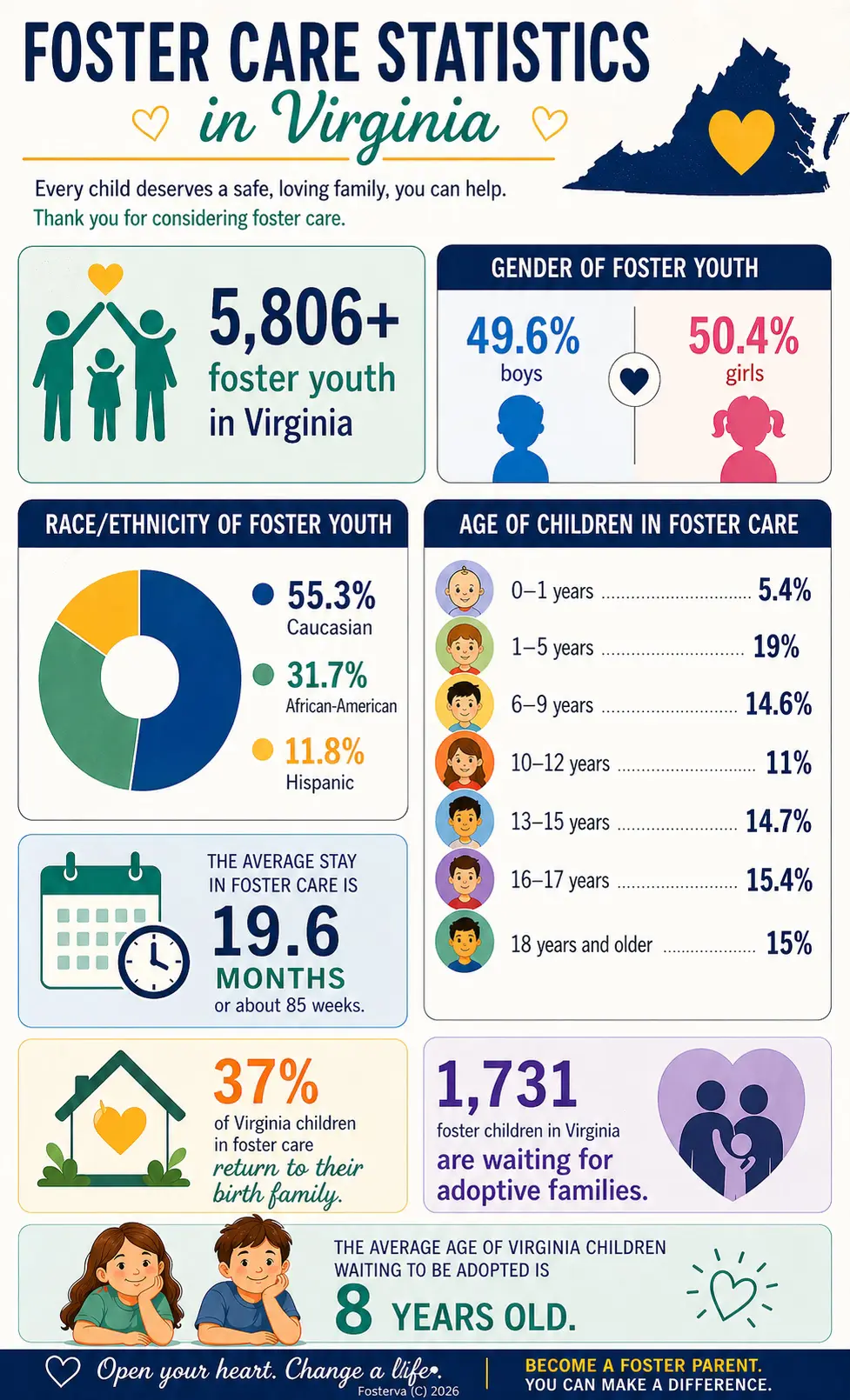
 Physical
Physical abuse refers to intentional physical harm to another person. It does not refer to punishments such as spanking if it is reasonable. Still, if it causes bodily injury to the child, it is abuse.
Learn More https://www.fosterva.org/blog/signs-of-abuse-the-different-types-of-child-abuse#neglect-abuse Emotional
Emotional abuse includes constant criticism, threats, rejection, and withholding of love or guidance. However, each act prevents children from learning proper emotional regulation and lowers their sense of self-worth. The child is often told that their abuse happens because of a failure on the child's part, such as bad grades.
Learn More https://www.fosterva.org/blog/signs-of-abuse-the-different-types-of-child-abuse#emotional-abuse Sexual
Unfortunately, those in or who have been in foster care are at a much higher risk of becoming victims of human trafficking. Foster parents should be aware of the signs of human trafficking. It allows them to educate and prevent the children in their care from becoming victims.
Learn More https://www.fosterva.org/blog/signs-of-abuse-the-different-types-of-child-abuse#sexual-abuse Neglect
Child neglect is a form of abuse that can cause physical and psychological issues in children. A caretaker fails to provide for a child's basic needs physically, emotionally, medically, or even educationally.
Learn More https://www.fosterva.org/blog/signs-of-abuse-the-different-types-of-child-abuse#neglect-abuse 50%
50%
50% of girls who have been in foster care are pregnant by the age of 21. (Source)
 38%
38%
38% of foster care youth have experienced homelessness before the age of 26. (Source)
 80%
80%
80% of former foster children are diagnosed with Post Traumatic Stress Disorder (PTSD)(Source), which is twice that of US veterans. (Source)
 55%
55%
Only 55% (Source) of foster care youth will graduate high school by 19 compared to 92.7% of non-foster care kids in 2025. (Source)
 30%
30%
Nearly one in three foster youth will be incarcerated by the age of 21. (Source)
 8
8
While many believe most kids in foster care are very young, the average age of a child entering foster care is eight years old. (Source)